AI Receptionist Moving Company: Capture Every Quote
Your three-man crew is mid-load on a four-bedroom move, sofa wedged in a stairwell, nobody near a phone. A quote request comes in for a job next Saturday. The caller has already dialed two other movers. Whoever runs a real intake first usually books the deposit. An AI receptionist moving company desk answers that call on the first ring and captures the whole quote — while your hands are full of someone else’s couch.
That is the entire pitch for this page: not “we pick up the phone,” but what the AI actually does with the call your crew physically can’t take. Here’s how it works, turn by turn.
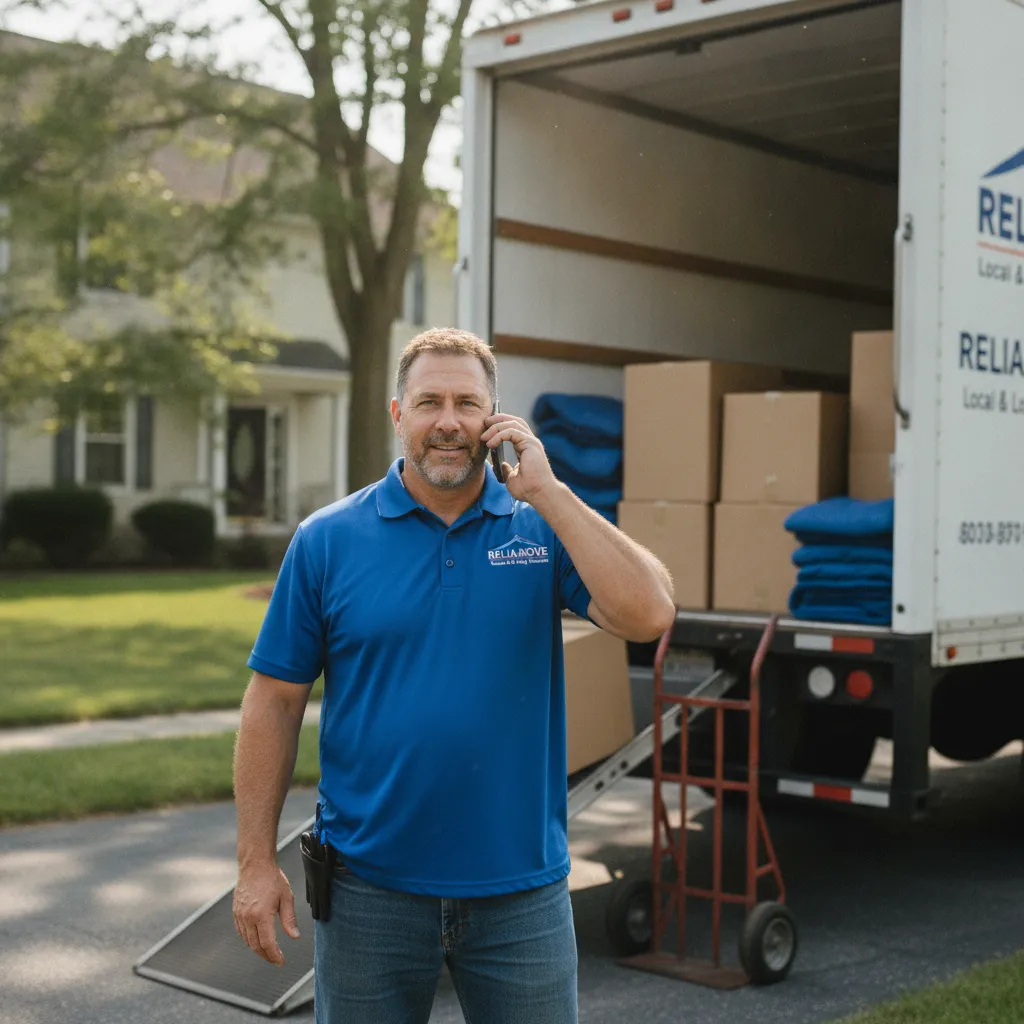
What an AI Receptionist for a Moving Company Captures
The gap between voicemail and a useful AI receptionist is what it collects before the caller hangs up. A moving quote isn’t a name and a number — it’s a set of fields your estimator needs to price the job. A well-configured AI receptionist runs that full intake live.
For a moving company, every inbound quote call captures:
- Move type — local, long-distance, or commercial
- Origin and destination — addresses or at least city and zip, for routing and crew assignment
- Move date — a firm date or a target window if they’re still deciding
- Home size — studio, two-bedroom, four-bedroom, full house, office
- Access details — stairs, elevator, long carry, parking or truck-size limits at either end
- Specialty items — piano, gun safe, artwork, pool table, gym equipment
- Contact — name and best callback number
When those fields land during the call, your first follow-up isn’t a cold callback asking the same questions over again. It’s a quote conversation with the numbers already half-built. That shift — from “let me take your info” to “here’s your estimate” — is where a warm lead turns into a booked job.
The Quote Call, Turn by Turn
Here’s an illustrative intake — a scripted demo, not a recording of a real customer call. A homeowner planning a local two-bedroom move calls at 6:40 PM, after your office has closed for the day.
[0:00] Phone rings. AI answers.
AI: “Thanks for calling Summit Moving — this is the booking desk. Are you looking to get a quote on a move?”
[0:06]
Caller: “Yeah, I’m moving from a two-bedroom apartment to a house across town.”
[0:12]
AI: “Great, congrats on the new place. Is this a local move within the same metro, or longer distance?”
[0:18]
Caller: “Local. Both in Riverside.”
[0:22]
AI: “Perfect. What’s the move date you’re targeting, or a rough window if it’s not locked in yet?”
[0:28]
Caller: “Probably the second Saturday of next month.”
[0:33]
AI: “Got it. For the apartment — what floor is it on, and is there an elevator or just stairs?”
[0:39]
Caller: “Third floor, no elevator. The new house is a single story.”
[0:45]
AI: “Noted — third-floor walk-up on the pickup, single story on the drop. Anything heavy or specialty? Piano, safe, big workout equipment?”
[0:53]
Caller: “A treadmill and a pretty big sectional. That’s it.”
[0:58]
AI: “Good to know. Best number for the estimator to text your quote to?”
[1:03]
Caller: “951-555-0148.”
[1:08]
AI: “Let me confirm: local two-bedroom, third-floor walk-up in Riverside to a single-story Riverside home, second Saturday next month, treadmill and a large sectional, callback 951-555-0148. I’ll get this to our estimator tonight and you’ll have a quote in the morning. Anything else?”
[1:21]
Caller: “No, that’s perfect, thanks.”
Eighty-one seconds, after hours, with no human at the desk. Seven fields captured: move type, origin and destination, date, home size, access, specialty items, callback. The estimator opens the morning with a ready-to-price job, not a voicemail that says “hi, I’m moving, call me back.”
When the AI Books, Flags, or Transfers
Not every call is a clean residential quote, so the AI follows the routing rules you set.
Standard quote calls get the full intake above, then a structured summary to your estimator. No human needed.
Complex jobs get captured and flagged. A commercial office relocation with elevator reservations, certificate-of-insurance requirements, or union-labor clauses still gets a complete intake — the AI just tags it “commercial, needs estimator follow-up” so it doesn’t get treated like a studio apartment.
Urgent or live-person requests transfer. If a caller has a move-day problem in progress, or simply asks to speak to a person, the AI does a warm transfer to the number you designate and holds the caller until it connects. You define the triggers; the AI doesn’t guess. This is the same escalation architecture we describe in our breakdown of how AI handles emergency calls — the AI makes the route decision in real time, not after a callback.
One thing the AI does not do is invent a price. Moving quotes depend on distance, cubic footage, access, specialty items, and season — variables that need a real estimate. The AI captures every input your quoting process needs and tells the caller when to expect their number. It never quotes a figure it can’t stand behind.
What the AI Needs to Know About Your Moving Business
An AI receptionist doesn’t arrive knowing your operation. What it needs to learn is finite, and you provide it as a description of how you book moves — not as a software integration project.
The categories it needs:
Service area. The metros, corridors, and distance bands you cover. “We do local moves within the Inland Empire and long-distance to anywhere in California and Arizona. No interstate east of Texas.”
Service menu. What you handle and what you refer out. Full-service packing, labor-only, piano moves, storage, junk removal — and the lines you don’t cross.
Intake questions. The exact fields your estimator needs to price a job. The AI asks them in the order you want, every call, and never skips one.
Routing and escalation rules. What counts as a standard quote, what gets flagged commercial, and what transfers to a live person — with the primary and backup numbers.
Hours and after-hours posture. Whether the AI is your overflow during the day, your full coverage after 5 PM, or both, and how after-hours quote requests should be logged or routed.
Greeting style. Your company name, the persona name, and the opening line the AI uses when it answers.
None of this is a technical build. It’s a description of your booking process in plain terms — closer to briefing a new office hire than configuring a phone system. For the field-by-field version of the intake, our moving company intake script walks the five questions that should anchor every quote call.
What Happens After the Call Ends
Every call — booked, flagged, or transferred — produces three outputs within seconds.
Lead summary. Your estimator or office manager gets a text and email with the full intake: name, callback number, move type, origin and destination, date, size, access notes, and specialty items. No transcription, no deciphering a sticky note at 8 AM.
Searchable log. The call is recorded and transcribed in your dashboard, so you can pull up exactly what was said and captured. Useful when a caller insists they mentioned a piano they didn’t.
Prioritized queue. Because intake is structured, you wake up to a ranked list of warm quote requests instead of a voicemail pile — the same-day movers and big jobs sorted to the top.
That speed matters because moving leads decay fast. Harvard Business Review’s study of 2,241 companies found that firms responding within an hour were nearly seven times as likely to qualify a lead as those that waited even a few hours longer. When the intake is already done before you read it, your callback is a quote, not a starting line.
AI Receptionist Moving Company vs. a Message-Taking Service
A traditional answering service picks up and takes a message: name, number, “wants a moving quote.” Someone calls back later, re-asks every question, and hopes the caller hasn’t already booked the mover who answered first.
An AI receptionist moving company desk runs the entire intake on the call, makes the route decision live, and delivers a structured, ready-to-price summary in seconds. The estimator knows the job before the caller’s phone is back in their pocket.
The difference isn’t the technology — it’s whether the call captures enough to act on or just records a number to chase. The broader trade-offs across live agents, AI, and hybrid models are laid out in our AI receptionist vs. answering service pillar. And the speed-to-lead math that makes any of this worth doing is in our breakdown of why a moving company answering service that beats the five-minute window wins jobs your trucks never lose on price.
Frequently Asked
Q: What does an AI receptionist for a moving company actually do that voicemail doesn’t? A: It answers live, runs a full quote intake — move type, origin and destination, date, home size, access, specialty items, callback — and sends a ready-to-price summary in seconds. Voicemail gets a name and a vague “I’m moving.” The AI gets everything your estimator needs to quote.
Q: Can the AI give callers a price over the phone? A: No, and it shouldn’t. Moving prices depend on distance, volume, access, and season, which need a real estimate. The AI captures all the inputs your quoting process requires and tells the caller when their quote will land, so your first callback is the number, not another round of questions.
Q: Does it handle commercial and long-distance moves, or just local? A: Both. The intake fields are the same; the AI just flags commercial and long-distance jobs for estimator follow-up so they don’t get priced like a studio apartment. You define which job types route where.
Q: What if a caller wants to talk to a real person? A: The AI warm-transfers to the number you designate and holds the caller until it connects. You set the triggers — same-day moves, complex commercial jobs, or any caller who simply asks for a person. Everything else, it handles end to end.
Q: Does it work with my existing business number? A: Yes. You forward your published number to the AI or use a forwarding number you control. Your public number doesn’t change and your current calls don’t need rebooking.
Hear It Run a Real Moving Quote
The after-hours call at the top of this page is exactly the kind of quote your crew can’t stop a load to take. An AI receptionist moving company desk takes it, captures the full intake, and has it on your estimator’s screen by morning. Book a 15-minute demo and hear it run an intake on your own line.