HVAC Call Answering Service: Live Agent, Hybrid, or AI — What Fits Your Shop
Every HVAC shop has a version of this problem: the phone rings at 9:47 PM on a Thursday in July, your tech is finishing a condenser job, and no one picks up. The homeowner calls the next company in the Google results. That’s a $400-to-$2,000 job walking to a competitor — a scenario that repeats dozens of times each peak season if your call answering setup isn’t built for your shop’s actual hours and volume.
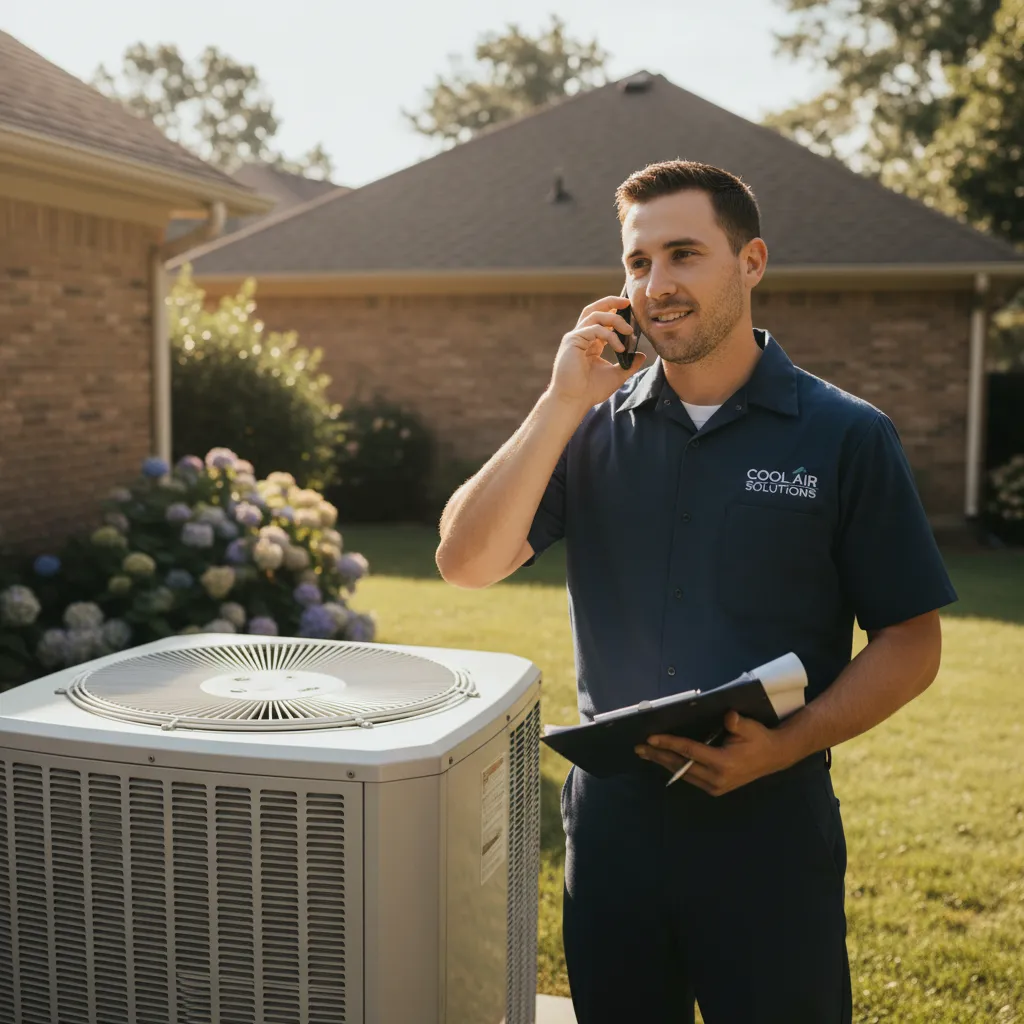
An HVAC call answering service closes that gap. But “answering service” covers three very different models — live agents, hybrid setups, and AI — plus two dimensions that cut across all three: how trade-literate the intake actually is, and how the service handles the calls that land after your office closes. Each combination has a different cost profile, coverage window, and failure mode. This guide lays out the decision criteria so you can match the model to your operation before you commit.
What an HVAC Call Answering Service Actually Does
At its core, any hvac call answering service does three things: answers the phone when your office can’t, captures the caller’s name, number, and problem, and either books the appointment or routes the call to your dispatch team. The difference between models is who — or what — handles that work, when, and at what cost.
A voicemail gets you a name and number on a good day, and most callers hang up without leaving either. A real answering service runs the intake — the same questions you’d ask standing at the counter with a clipboard. For an HVAC call, that intake usually covers:
- The problem in the caller’s words — “no cool upstairs,” “smells like something’s burning,” “compressor won’t kick on.”
- System type and rough age — split system, heat pump, mini-split, rooftop unit; a 20-year-old unit is a replacement conversation, not a repair one.
- Urgency signals — infant or elderly in the home, indoor temperature, total outage versus partial.
- Service address and ZIP — so out-of-area calls get a polite decline instead of a wasted truck roll.
- Best callback number, captured early — so a dropped call still leaves you a workable lead.
The good ones hand you a structured lead and a transcript by SMS and email within seconds of the call ending, not a recording you replay twice trying to catch a phone number. That handoff is the whole point: the morning crew rolls up already knowing it’s a no-cool call on an aging system, not “call this number back, didn’t catch why.” For the deeper catalog of what a trained HVAC script captures on every call, see our AI receptionist for HVAC overview.
Live Agent HVAC Answering Services: Who They Work Best For
A live-agent hvac answering service routes your after-hours calls to a call center staffed by human operators, typically on a shared or dedicated basis. The operator follows a script you provide, captures the lead, and either transfers hot calls directly to your on-call tech or queues the intake into your dispatch system.
What works: Human agents handle off-script callers better than any automated system. If someone is rattled — no AC during a heat advisory, elderly tenant on oxygen — a live agent can slow down, offer reassurance, and adapt on the fly. Every call is also auditable: you can pull the recording, hear exactly what was captured, and train to the gaps.
What doesn’t work: Cost scales with call volume. Live-agent services typically run $75 to $250 per month for a base package plus $0.75 to $1.50 per call on shared plans, or $1.25 to $2.50 per minute on dedicated lines. During a storm-surge event — when you most need the coverage — shared call center agents are fielding your competitors’ calls at the same time. Average hold times climb precisely when caller urgency is highest. If your peak-season volume is 4x your baseline, the per-call bill climbs with it.
Best fit: Shops handling under 30 after-hours calls per month, where the premium for a human voice is worth the per-call cost. Also the right choice if commercial SLAs require documented live-answer capability or if your caller base skews older and is more likely to disengage with automation.
Hybrid Answering Services: The Middle-Ground Option
Hybrid services combine AI intake screening with human backup. The AI handles the first leg — name, address, problem type — and routes calls it can’t resolve to a live agent. Routine bookings stay with the AI; complex or urgent calls escalate to a person.
What works: Lower per-call cost than pure live-agent, with a human safety net for edge cases. Hybrid services typically range from $99 to $400 per month depending on volume. If your volume is moderate and you’re not ready to go full AI, a hybrid reduces risk. Some hybrid providers build HVAC-specific scripts that mirror standard triage logic for the AI intake layer.
What doesn’t work: Every hand-off between AI and human introduces a seam in the call experience. A caller who goes from an automated menu to a hold queue to a live agent to a voice message isn’t having a clean intake. The value of hybrid depends almost entirely on how fast the AI-to-human escalation happens. If that transition takes four to eight minutes during a surge, the caller has already moved on.
Best fit: Shops fielding 30 to 80 after-hours calls per month with mixed call types — some routine scheduling, some true 24/7 hvac answering service emergencies. Also works for multi-location operations that need consistent intake across locations but want human fallback for commercial accounts.
AI Answering Service for HVAC: Full Coverage, Flat Cost
An AI-powered hvac call answering service handles every inbound call autonomously — asking the qualifying questions, capturing the lead, and booking or flagging the emergency — without a live agent in the loop. The AI answers on the first ring, follows your intake script exactly every time, and never puts a caller on hold because it’s busy with another call.
What works: Once you’re past the flat monthly fee — generally $99 to $299 per month depending on provider and volume tier — there is no per-call cost. The math changes dramatically during peak season: if July brings 250 after-hours calls and a live-agent service costs $1.00 per call, that’s $250 in variable cost that an AI service at a flat rate doesn’t carry. More importantly, the 24/7 hvac answering service is available at 3 AM on a holiday weekend without staffing overhead. According to BrightLocal’s Local Consumer Review Survey, 62% of consumers now expect a business to respond to an inquiry the same day — a bar that voicemail and next-day callbacks routinely miss. AI answering is the only model that meets that expectation at any hour with no incremental cost.
What doesn’t work: AI handles scripted intake cleanly, but struggles with callers who can’t describe their problem — “it’s making a noise, I don’t know what it is.” It also performs worse with callers who are highly distressed or who want to talk through a problem rather than answer intake questions. The right AI deployment acknowledges this and offers a clear path to a human callback, not a dead end.
Best fit: Shops handling 80 or more after-hours calls per month, or any shop that wants consistent after-hours intake without managing a call center vendor relationship. The strongest fit is for shops that have already standardized their intake logic — if you know exactly what questions to ask and what urgency criteria look like, AI executes that without variance. The weak point is a generic, multi-industry script: one built for a dentist’s office can’t tell a capacitor swap from a no-heat emergency, and it books both the same way. A trade-literate script that knows “no cool” in July and “no heat” in January are emergencies, while a noisy fan can wait for business hours, is what separates a specialist deployment from a generalist one. See our AI receptionist vs. answering service pillar for the trade-by-trade breakdown, and the AI receptionist vs. hiring a dispatcher cost model.
After-Hours and Emergency Call Handling: Where Every Model Gets Tested
For a typical residential shop answering 8 to 5 on weekdays, “after hours” is roughly 128 of the week’s 168 hours — about three-quarters of the calendar. HVAC emergencies cluster in exactly that window, because equipment fails when it’s working hardest: late-afternoon and evening heat in summer, overnight cold in winter. So the calls that land after hours skew urgent and expensive, and they’re the ones most likely to hit a voicemail box if you don’t have a plan. If voicemail is still the plan, at least record an after-hours greeting with an emergency path.
The most common DIY fix — routing after-hours calls straight to an on-call tech’s cell — quietly fails for a human reason. At 9 PM after a ten-hour day, “I’ll call them back after this job” turns into “I’ll catch them at 7 AM,” and by 7 AM the homeowner has booked somebody else.
A family with no heat at midnight in February, or a commercial building losing cooling during a heat emergency, is where every model gets stress-tested:
| Model | Response time | Surge capacity | Escalation path |
|---|---|---|---|
| Live agent | Fast, if staffed | Limited — shared agents may queue | Transfer to on-call tech |
| Hybrid | Variable | Better than live-only | AI screens, human closes |
| AI | Instant, every call | Scales with call volume | Flags and alerts on-call tech |
The variable none of the models control on their own: the escalation path to your actual technician has to be designed correctly before any service handles your calls. An AI answering service that captures a no-heat emergency and sends a text to a phone number no one monitors at midnight is functionally the same as voicemail. Write the escalation rules tight — decide what counts as a genuine emergency (no heat with an infant in the home, a total outage in extreme weather) and let everything else book itself for the morning, so your on-call tech only gets pinged for calls that earn it. For the specific decision tree that separates urgent HVAC emergencies from schedulable calls in under 60 seconds, see the HVAC emergency triage guide.
How to Evaluate an HVAC Answering Service Before You Buy
“Best” is the wrong question if it means a leaderboard. The right HVAC call answering service isn’t a brand — it’s the one that fits how your shop actually books work. Four checks separate the ones that book jobs from the ones that just log calls. Run a real call through any service you’re considering and watch how it handles each one:
- Real intake, not a message pad. It should ask your questions — system type, urgency, ZIP — not just “name and number, someone will call you back.” A generic call-center script that can’t tell a tune-up from a total outage will book the wrong jobs and miss the ones that pay.
- Booking on the call. Capturing the lead is half the job. Look for direct booking into Google Calendar or your scheduling tool during the call, respecting your hours and blackout windows so it won’t drop an appointment on top of one you’re already running.
- A real escalation path. Emergencies need a human. The service should warm-transfer flagged calls to your on-call number and fall back to voicemail-with-transcript if nobody picks up.
- You control the script. Your greeting, your company name, your service area, your urgency rules. If you can’t define what “urgent” means for your shop, the service is guessing — and it’ll guess wrong on the calls that matter most.
Once a service passes those four, match it to your operation with these questions:
- Monthly after-hours call volume? Under 30, live agent is cost-competitive. Between 30 and 80, hybrid starts to make financial sense. Over 80, AI has the lowest total cost of ownership.
- Peak-to-baseline ratio? HVAC is uniquely seasonal — if July call volume is 4-5x your February baseline, you need a model that scales elastically. Live-agent bills per call, so your costs spike with volume; AI is flat-fee regardless.
- What share of after-hours calls are true emergencies versus scheduling? If most are no-cool or no-heat emergencies, your escalation logic is the whole product. If most are quote requests or next-day scheduling, AI handles that set cleanly with no escalation needed.
- Do you have commercial accounts with response SLAs? Some contracts specify documented live-answer capability. Verify an AI or hybrid service meets that contractual language before switching.
You also don’t have to change your phone number to test any of this — you forward your existing published line, and the number on your trucks and Google listing stays exactly the same.
Frequently Asked Questions
Q: What should an HVAC answering service capture on every call? A: At minimum: caller name, callback number, service address, system type and approximate age, and urgency level. The intake should also flag safety factors — elderly resident, medical equipment, tenant situation — so the on-call tech has full context before the callback.
Q: How much does an HVAC answering service cost? A: Live-agent services typically run $75 to $250 per month for a base package plus $0.75 to $1.50 per call on shared plans. Hybrid services range from $99 to $400 per month. AI answering services are generally flat-fee monthly starting around $99 to $299 per month with no per-call charges. Pricing varies significantly by provider and volume tier.
Q: Can an AI answering service handle HVAC emergency calls after hours? A: Yes, provided the escalation logic is built into the intake script before deployment. The AI captures the call, qualifies urgency using your criteria, and sends an automated alert to your on-call tech for true emergencies. The intake design determines whether it works, not whether the technology is capable. See the HVAC emergency triage guide for the decision tree used to route calls correctly.
Q: What makes a specialty HVAC intake different from a generic answering service? A: A trade-literate script asks about system type, rough age, and the symptom in the caller’s words, because those answers decide whether you roll a repair truck, quote a replacement, or send a tune-up. A generalist script built for forty industries at once captures name and number and leaves the real intake for you to run on the callback — the work you were trying to hand off in the first place.
Q: Will HVAC callers hang up if they reach an AI? A: Some will, particularly callers who are distressed or who prefer to speak with a person. The risk is manageable with two design choices: a warm, natural AI voice that avoids robotic menu prompts, and a clear option to request a callback from a human. The more relevant comparison is against voicemail — callers who would hang up on AI also hang up on voicemail, and at least the AI captures the number before the hang-up in many cases.
Find the Right HVAC Call Answering Service for Your Shop
There is no universal answer here. A two-truck residential shop with mostly maintenance work has a different requirement than a 12-tech commercial contractor covering SLAs. The right model answers every call, captures clean intake, and escalates emergencies without creating work for your office staff. If you want the full catalog of what an AI script asks on a real HVAC call, see what an AI receptionist for HVAC captures and the questions a good HVAC call-qualifying script covers. For the broader after-hours playbook that applies across trades, see our after-hours answering service guide.
If you want to see how an AI answering service handles HVAC intake specifically — what it asks, what it captures, and how it routes urgent calls — book a 15-minute demo and we’ll walk through a live example.